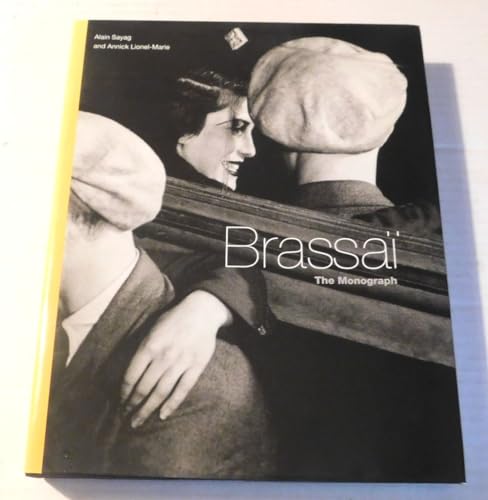
Brassaï: The Monograph
Published to accompany the Centre Georges Pompidou's retrospective of Brassaï's work, this monograph is the fullest English-language account of a photographer whose Paris after dark remains one of the defining bodies of 20th-century street photography.
Edited by Alain Sayag and Annick Lionel-Marie of the Pompidou's photography department, the book moves chronologically through Brassaï's career. It covers the nocturnal Paris pictures that made his name in the early 1930s, his work for the Surrealist journal Minotaure, his portraits of Picasso, Matisse, Dalí, and the wider Paris art world, and his later photographs of graffiti and sculptural form. Essays by Jean-Jacques Aillagon and Werner Spies frame the work critically. Roger Grenier and Lionel-Marie contribute additional texts, and an interview with Brassaï's widow, Gilberte, adds biographical material. Excerpts from Henry Miller and Jacques Prévert, both friends of Brassaï, appear alongside the plates, which draw largely on the Pompidou's own holdings.
Born Gyula Halász in Brassó, Transylvania, Brassaï took his name from his hometown after settling in Paris in 1924. Paris de nuit, his 1933 debut, established him as the photographer of the city's nocturnal life. The Secret Paris of the 30s later extended that project into the demimonde of bars, brothels, and cabarets. He also wrote on his friendships with Picasso and Henry Miller, and worked in sculpture, drawing, and film. This monograph, published in association with the International Center of Photography, remains the standard English survey of that range.