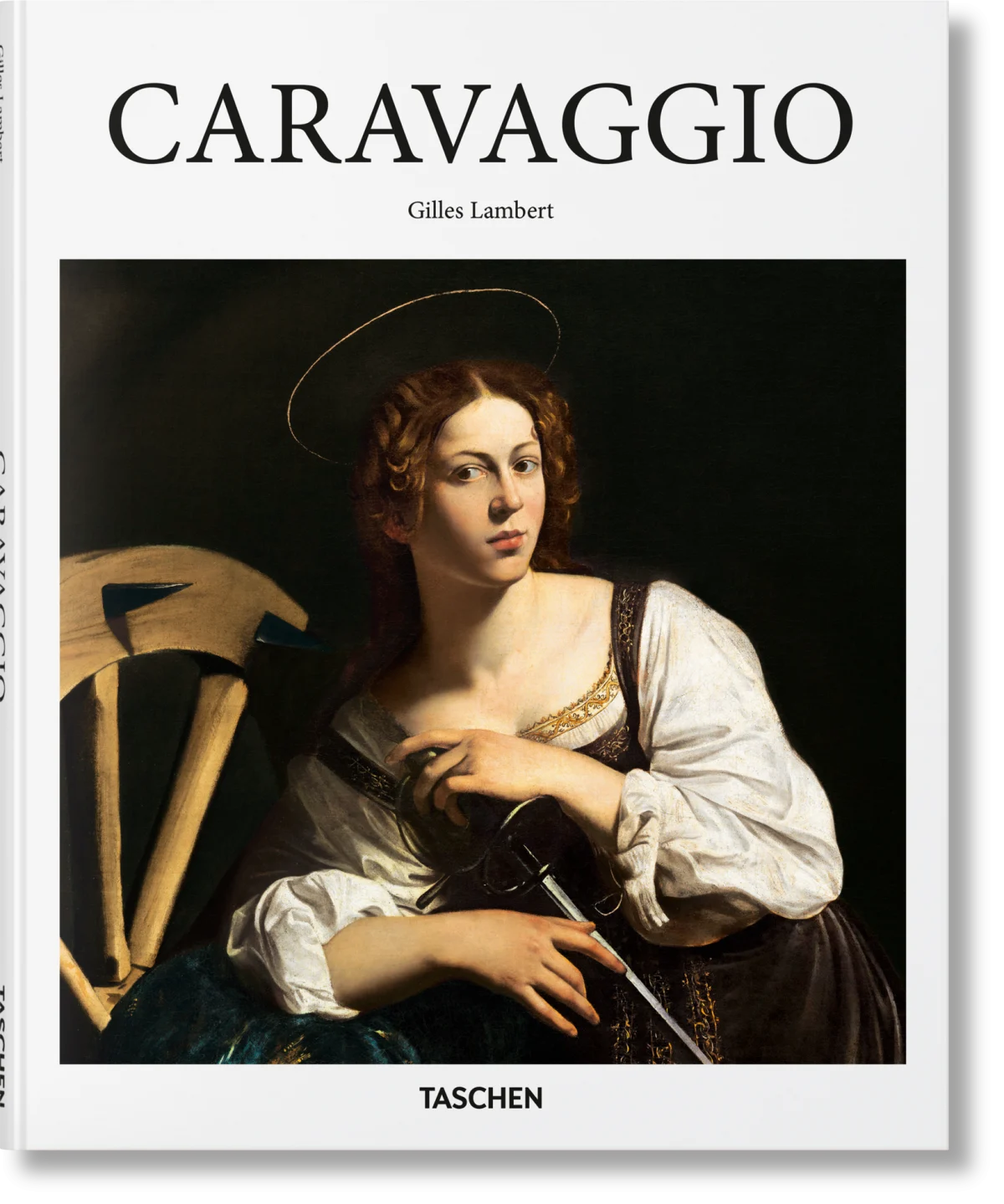
Caravaggio
Taschen's Basic Art volume on Caravaggio is a primer rather than a scholarly monograph, and it does the one thing that format does well: it puts more than fifty paintings in front of the reader in sequence and lets the argument for the early Baroque make itself.
Gilles Lambert sets the work against a short and violent biography — gambling, debt, brawls and a murder charge — and traces the theatrical naturalism, the models drawn from the street and the handling of light that made the pictures both scandalous and unignorable in their own moment. Like every title in the series, it carries a chronological summary of the artist's life and oeuvre, a concise biography, and captioned color plates throughout; Gilles Néret edited the volume for the Basic Art line, which Taschen began in 1985.
Michelangelo Merisi da Caravaggio (1571–1610) was largely written out of the canon after his death and recovered only at the end of the nineteenth century. He is now read as the pivot of the early Baroque, with a line of influence running through Ribera, Zurbarán, Velázquez, Georges de La Tour and Vermeer, and further on to Rembrandt, Delacroix, Courbet and Manet.