Solving German Codes in World War I
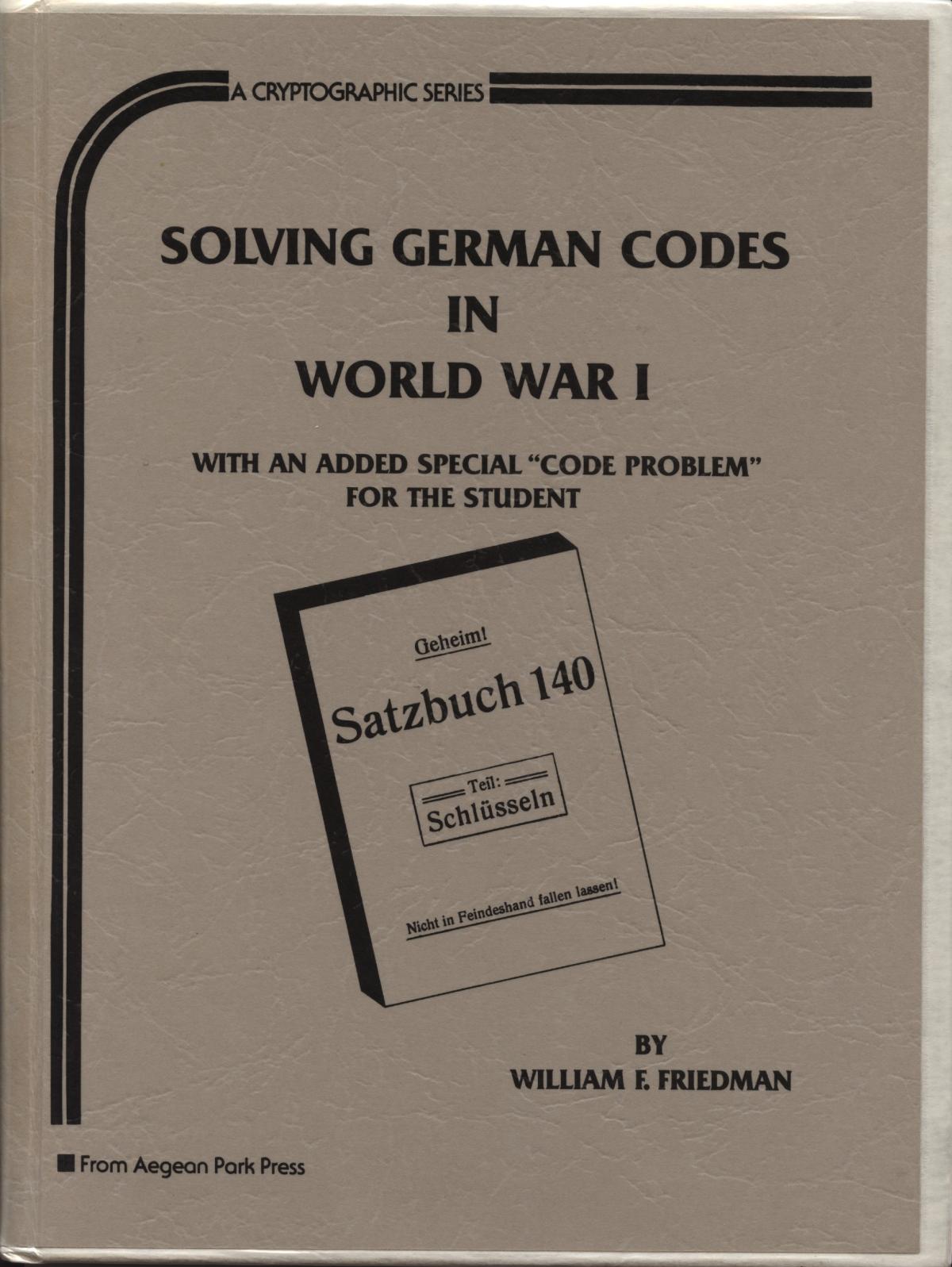
Solving German Codes in World War I is William F. Friedman's technical account of how German code systems, as distinct from cipher systems, were broken during the First World War, reissued by Aegean Park Press with, per its cover, "an added special code problem for the student."
The text covers how intercepted messages were prepared for study, the main classes of German code groups and their characteristics, solution by analogy to previously solved material, and the enciphering tables the Germans layered on top of their codebooks to complicate solution. Friedman appends a practice code problem in English so the reader can apply the methods he describes. The German trench codebook Satzbuch 140, reproduced on the cover, is representative of the field codes the text addresses.
Friedman worked on German codebooks as part of the American Expeditionary Forces' intelligence effort in France, building on the cryptanalytic training he had developed at Riverbank Laboratories before the war. He went on to become the US Army's chief cryptologist and one of the principal architects of American cryptology as a discipline.