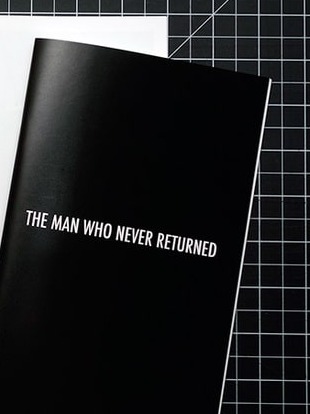
The Man Who Never Returned
The Man Who Never Returned takes a folk tale about a man who disappeared and turns it into an image-fiction that treats photographs as pure information, expanding and collapsing single moments until the picture itself starts to fail.
Andrew Hammerand built the book from digitally altered street photographs made in Boston: figures blur, ghost, and fracture inside the frame as data drops out mid-exposure. The disruptions read as glitches in surveillance itself, undercutting any confidence that a camera records a stable truth during a period of mass data collection. The Table, a small exhibition and publishing project run out of a Phoenix home, issued the book in 2014 to accompany Hammerand's exhibition of the same title: a staple-bound paperback of 48 pages in an edition of 250.
Hammerand, based in Boston, has built a body of work around privacy, authority, and digitized culture, most visibly in The New Town, made using a municipal surveillance camera and shown in Watching You, Watching Me at the Open Society Foundations in New York. The Man Who Never Returned extends that same scrutiny of the camera as an instrument of control into an explicitly fictional register.