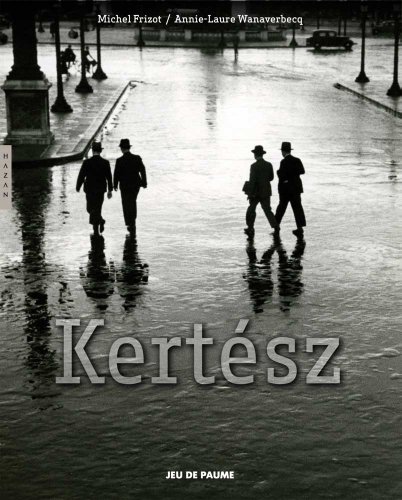
André Kertész
André Kertész, published by Éditions Hazan with the Jeu de Paume in 2010, surveys the full seventy-year career of the Hungarian-born photographer widely credited as a founding figure of modernist photography.
Compiled by Michel Frizot and Annie-Laure Wanaverbecq to accompany the Jeu de Paume's 2010 retrospective, the book reproduces roughly 500 images, including 18 color Polaroids, drawn from rare vintage and period prints. The 360-page volume covers three periods of Kertész's working life: Budapest from 1914 to 1925, Paris from 1925 to 1936, and New York from 1936 to 1985. Each section pairs an illustrated historical essay with a portfolio of the work and notes on his approach to composition, cropping, and the handheld Leica.
Kertész (1894–1985) began photographing as a largely self-taught amateur in Hungary. He settled in Paris in 1925, moved among Mondrian, Chagall, and the emerging Surrealist circle, and produced the geometric studies and Distortions nudes that shaped a generation of European photographers, Brassaï among them. He emigrated to New York in 1936 and worked for years in commercial photojournalism. Recognition as a major artist came late: John Szarkowski's 1964 Museum of Modern Art retrospective revived interest in his early European work.