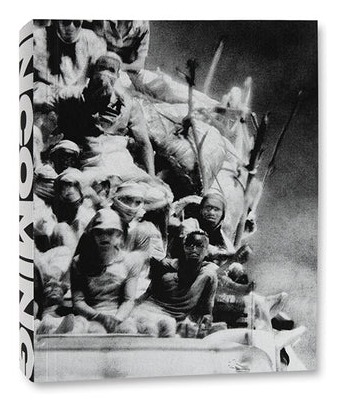
Incoming
Richard Mosse's Incoming turns a weapon on its subject and asks what is left of a person once a camera can only see their heat.
The 280 metallic tritone plates are stills from Mosse's three-screen video work of the same name, made with a thermal imaging camera classed as a weapons component under international export law, able to detect a human body from some 30 kilometres away. Following migration routes across the Middle East, North Africa and Europe, the images show rescues off the Libyan coast, crossings of the Sahara and the burning of camps, all rendered as heat signatures in which faces, skin and clothing dissolve into a monochrome scale. MACK published the 576-page volume in 2017 as an OTA-bound softback with a metallic silkscreened cover, at 17.5 x 19.7 cm, with a text by the philosopher Giorgio Agamben.
Mosse has worked for over a decade at the point where documentary photography meets military optics, most visibly in Infra and The Enclave, which used discontinued Kodak Aerochrome infrared film to photograph the conflict in eastern Congo. He represented Ireland at the 55th Venice Biennale and won the Deutsche Borse Photography Prize in 2014. Incoming extends that method from a single conflict to the border apparatus itself.