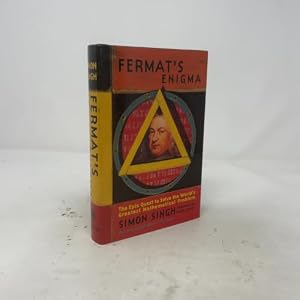
Fermat's Enigma: The Epic Quest to Solve the World's Greatest Mathematical Problem
Fermat's Enigma tells the story of Fermat's Last Theorem. Pierre de Fermat left it unproved in a 1637 margin note, claiming a proof too large to fit the page. The search for that proof lasted 358 years before Andrew Wiles closed it in 1994.
Singh traces the theorem through the mathematicians who attempted and failed to prove it, including Euler, Sophie Germain, Cauchy, Lame, and Kummer. He then turns to Wiles, who worked in secrecy for seven years at Princeton. Wiles's approach connected the problem to the Taniyama-Shimura conjecture linking elliptic curves and modular forms, a link Ken Ribet had shown would settle Fermat's theorem if proved. Wiles's first announced proof, in 1993, contained a gap that took another year of work with Richard Taylor to close. This US edition carries a foreword by John Lynch, who directed the BBC documentary The Proof on which the book is based. The UK edition was published as Fermat's Last Theorem.
Singh is a BBC science journalist with a doctorate in particle physics from Cambridge. This was his first book. It became the first mathematics book to reach number one on the UK bestseller list, and he went on to write The Code Book, a history of cryptography, and Big Bang.