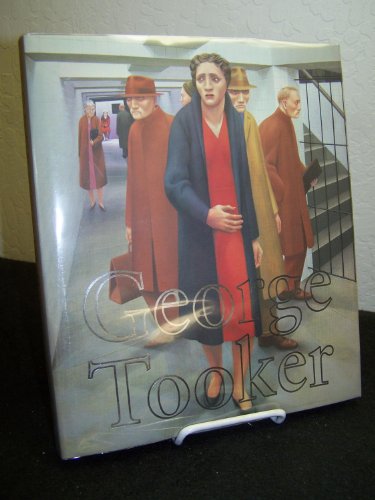
George Tooker
George Tooker painted the twentieth-century American crowd as a place where nobody meets anybody — subway corridors, waiting rooms, government offices — and this retrospective volume, the first in thirty years, finally treats him as a serious formal painter rather than an illustrator of alienation.
Published by Merrell in 2008 for George Tooker: A Retrospective, organised by the Pennsylvania Academy of the Fine Arts and shown there, at the National Academy Museum in New York and at the Columbus Museum of Art. Edited by Robert Cozzolino, Marshall N. Price and M. Melissa Wolfe, the 192-page volume reproduces more than eighty works in colour and carries new essays by the three editors with Anna C. Chave, Thomas H. Garver and Jonathan Weinberg, addressing Tooker's obsessive approach to composition, his Catholicism and the question of identity that runs beneath the paintings. A chronology, exhibition history, bibliography, checklist and index complete the book, issued in silver-stamped boards.
Tooker (1920–2011) worked almost exclusively in egg tempera, a slow medium he learned from Paul Cadmus, producing only a few paintings a year across a career of six decades; The Subway (1950) and Government Bureau (1956) are the pictures by which most people know him.