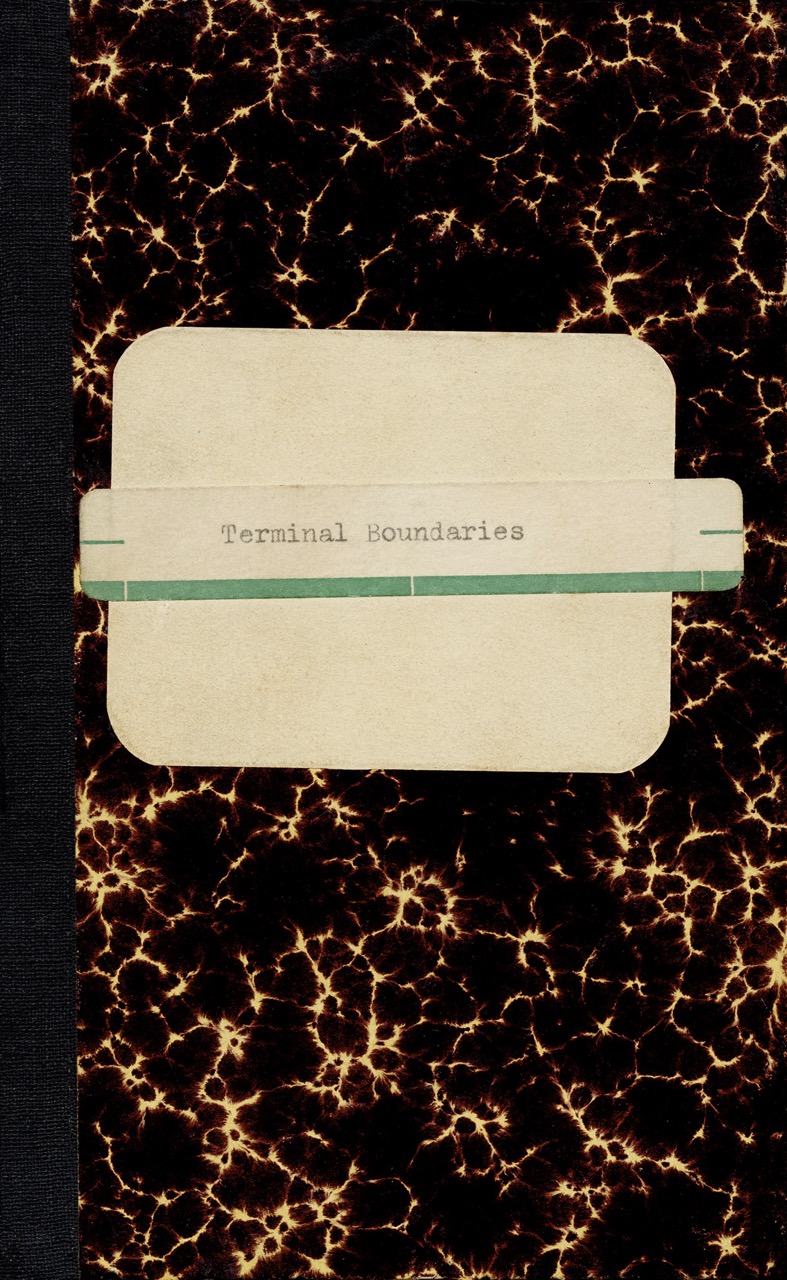
Terminal Boundaries and A natural water course diverted reduced or displaced
Terminal Boundaries and A natural water course diverted reduced or displaced is a tête-bêche artist book by Lawrence Weiner, originally created in 1969 but never published until now. The manuscript contains two related bodies of work represented as typewritten statements on paper that Weiner pasted to the pages of a small composition notebook purchased in a European stationery store. Primary Information publishes this facsimile edition in Spring 2026, making available for the first time a pivotal work from one of conceptual art's founding figures.
Lawrence Weiner (1942-2021) was one of the central figures in the formation of Conceptual Art in the 1960s, exploring the potentials of language as a sculptural medium. In 1968, he published his influential "Declaration of Intent": "The artist may construct the piece. / The piece may be fabricated. / The piece need not be built." Terminal Boundaries marks a crucial inflection point in Weiner's practice, created just as he was making his decisive turn toward work centered in language. Despite being considered a founding father of Conceptual Art, Weiner rejected the label and preferred instead to call himself a sculptor.
The artist was traveling across Europe when this manuscript was composed in 1969, struck by the tumultuous times and critical illuminations about climate from the Club of Rome discussions. The works are concerned with the relationship of natural resources in relation to human beings, attempting to present something that is "not just about me," as Weiner stated, but about materials and the world we find ourselves in the here and now. The tête-bêche format—two books in one, read from opposite ends—reflects the duality of these concerns.
Weiner's work is held in major museum collections including MoMA, the Guggenheim, Tate Modern, and the Whitney Museum of American Art. His practice influenced generations of artists working with language, and he designed his own typeface, Margaret Seaworthy Gothic, to convey the particular poetic spirit of his work. This publication represents a significant addition to the artist's bibliography, revealing an early chapter in his development of language-based art that would define his five-decade career.