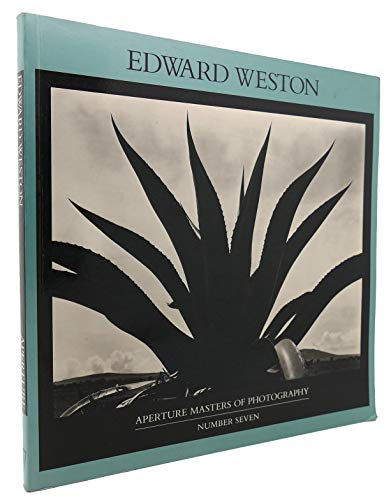
Edward Weston
Edward Weston, the seventh volume in Aperture's Masters of Photography series, is a compact survey of the career of one of the founders of American modernist photography.
Over 95 pages, R.H. Cravens's essay traces Weston's move from soft-focus pictorialism toward the sharp-focus, unmanipulated approach he called “straight photography,” and the plates follow him through the images that made his reputation: close-up nudes, the shell and pepper still lifes shot for their pure abstract form, and the dune and rock studies made at Point Lobos and Oceano on the California coast. The series format keeps the text brief and lets the reproductions carry the book, a design consistent across the other Aperture Masters volumes on Weston's contemporaries.
Weston (1886–1958) co-founded Group f/64 with Ansel Adams and Imogen Cunningham in 1932 to advocate for sharply focused, unretouched photography, and in 1937 became the first photographer awarded a Guggenheim Fellowship. His negatives and the bulk of his working archive are held at the Center for Creative Photography at the University of Arizona, with further material at the Museum of Modern Art, the Smithsonian, and George Eastman House.